


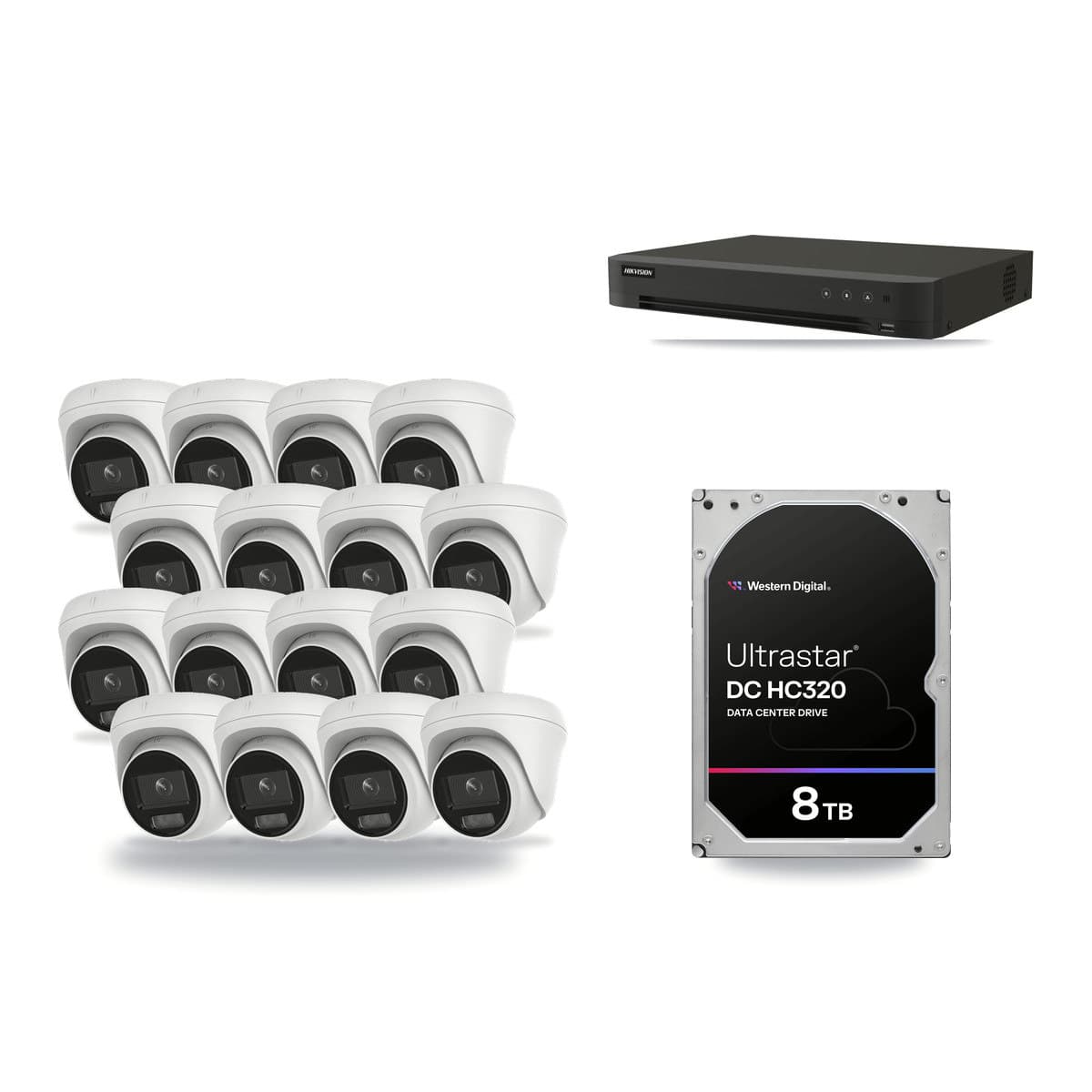
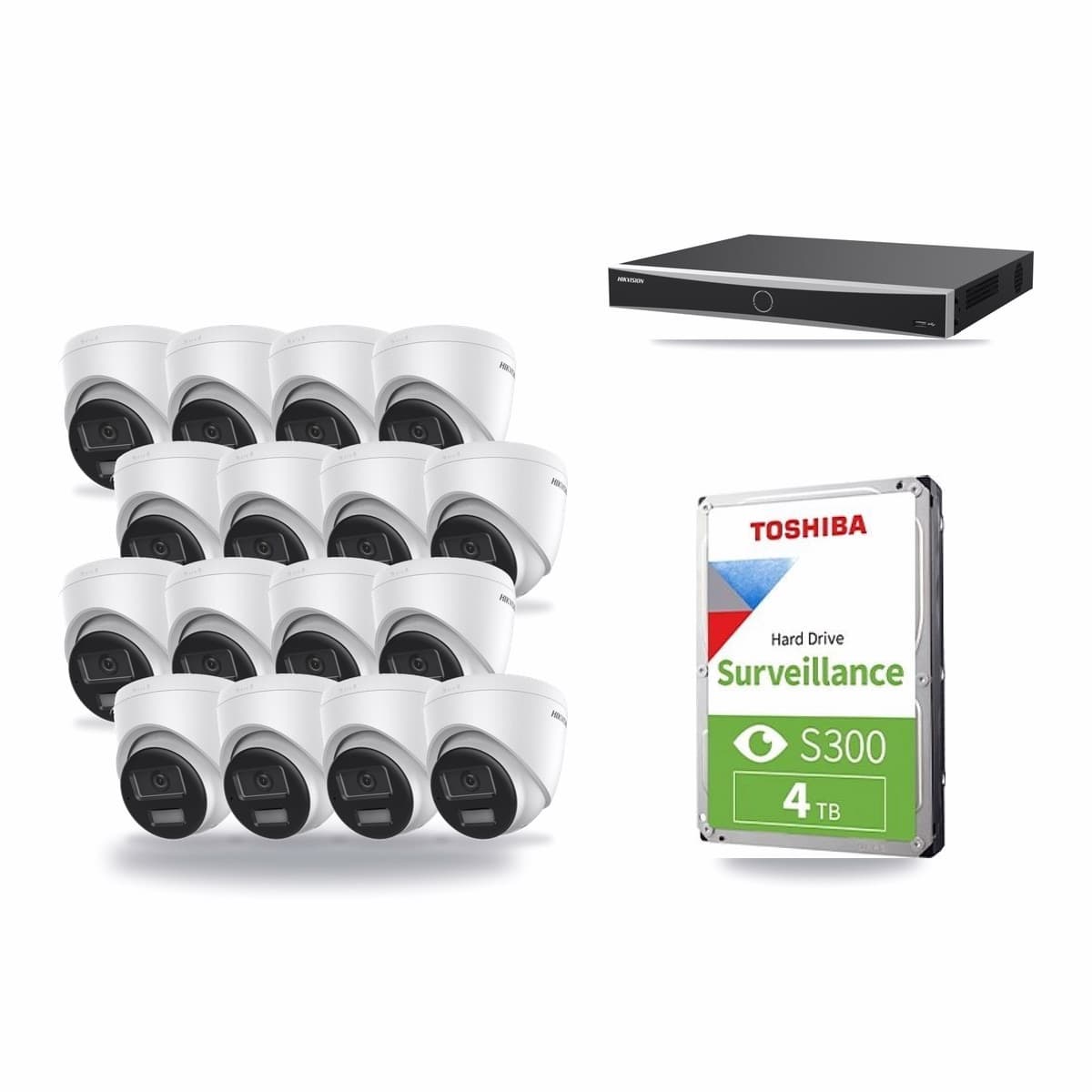
A 16-camera CCTV kit needs a 16-channel recorder, and the drive inside it decides how many days of footage you keep. With all sixteen cameras recording all day, a 4TB drive holds roughly six days at a steady 4Mbps a camera and an 8TB drive roughly eleven; both figures are estimates and the working is below. Check three things before you pick a kit: coax or PoE, the number of cameras you really need today, and the drive size.
What 16 channels means
A channel is one camera input on the recorder. A 16-channel recorder has sixteen inputs, so a kit with sixteen cameras uses every one of them, and a seventeenth camera would need a second recorder. We also sell 16-channel recorders with fewer than sixteen cameras, which leaves channels free for later.
Coax or PoE
We list 18 kits with sixteen cameras. Seventeen of them are Turbo HD (coax) kits and one is a PoE kit.
| Type | Kits | Recorder | Cabling in the box | Drive |
|---|---|---|---|---|
| Turbo HD, 3K and 5MP cameras | 11 | iDS-7216HQHI-M1/XT, 16 channels | Sixteen 20m RG59 BNC leads with a DC power tail, two 12V 5A power supplies with 8-way splitters | 2TB, 4TB, 6TB or 8TB |
| Turbo HD, 4K cameras | 6 | iDS-7216HUHI-M2/XT, 16 channels, 8MP | The same sixteen 20m leads and two power supplies | 4TB |
| PoE, 4K cameras | 1 | DS-7616NXI-K2/16P(E), 16-channel PoE NVR | Sixteen 20m Cat6 patch leads | 4TB |
Every kit includes the recorder with its drive already fitted and a 1.5m HDMI cable for the monitor. The coax kits are the Turbo HD kits: each camera has a lead that carries the picture and the power, and the power supplies sit beside the recorder. The PoE kit is in IP (PoE) kits: each camera takes power and sends its picture down one Cat6 cable. Pick by the cable you already have, or by what you are happy to run, because the cameras cannot be swapped between the two kit types: coax kit cameras use BNC leads, and PoE kit cameras use Cat6 to a PoE recorder.
Drive size and days recorded
The drive in the kit is already fitted and is the one that does the recording. The iDS-7216HQHI-M1/XT has one SATA drive interface and takes a drive of up to 12TB, so even the 8TB kits leave room to go larger later.
To estimate days, take a camera's bitrate in Mbps, multiply by 86,400 seconds in a day and divide by 8 to get megabytes a day. At 4Mbps that is 43,200MB, or about 43GB, and sixteen cameras write about 691GB a day. Counting 1TB as 1,000GB, that gives:
| Drive | Days at 4Mbps a camera | Days at 2Mbps a camera |
|---|---|---|
| 2TB | about 2.9 | about 5.8 |
| 4TB | about 5.8 | about 11.6 |
| 6TB | about 8.7 | about 17.4 |
| 8TB | about 11.6 | about 23.1 |
These assume every camera records all day and night at a steady bitrate. Your real figure depends on the recording settings, the camera resolution and how busy the scene is. Recording only when motion is detected stretches the days, and a busy scene or a higher resolution shortens them. If you need to keep footage for a set number of days, size the drive for the busy case and round up.
Which kit to start with
For a shop, warehouse or large house where every camera records constantly, the 8TB size gives the most days; the 16-camera 5MP kit with 8TB is one example. If your building is already cabled with Cat6, the 16-camera PoE kit uses that route. Measure each run from the recorder to the camera position first, because every lead in the kit is 20m long. Ask us before ordering if any run is longer.