
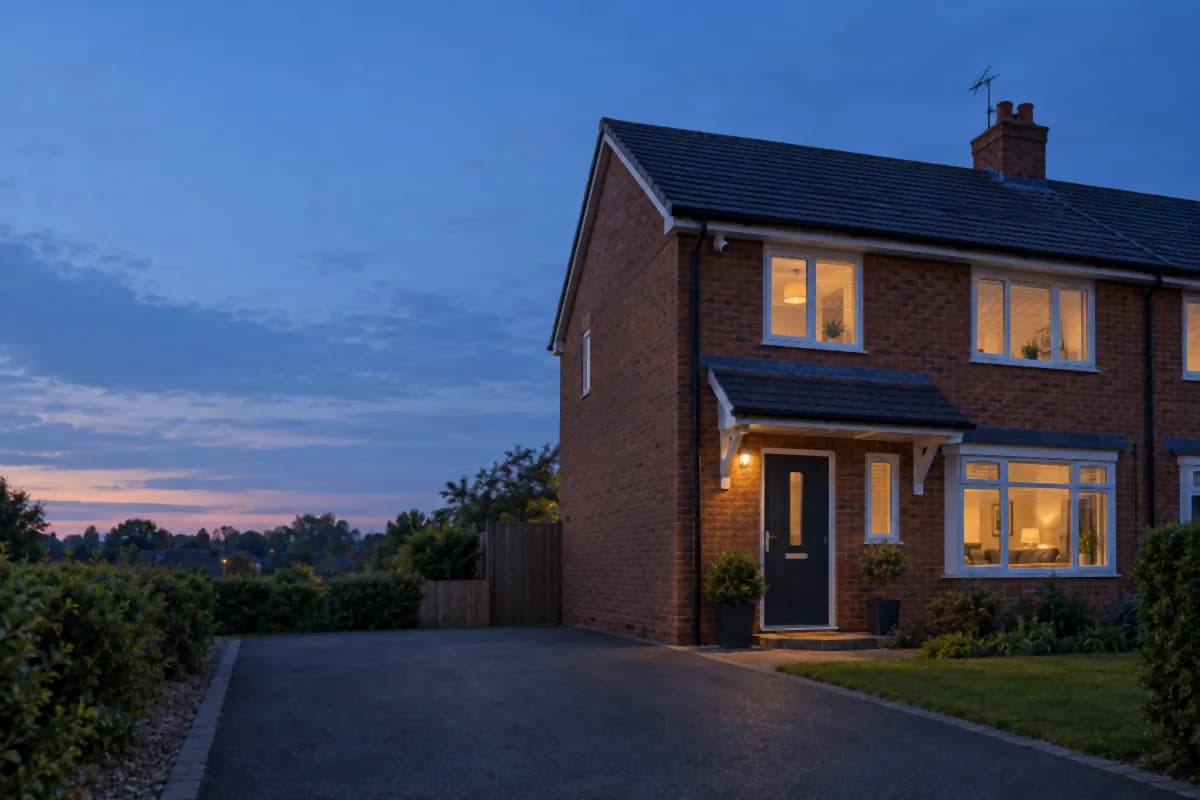
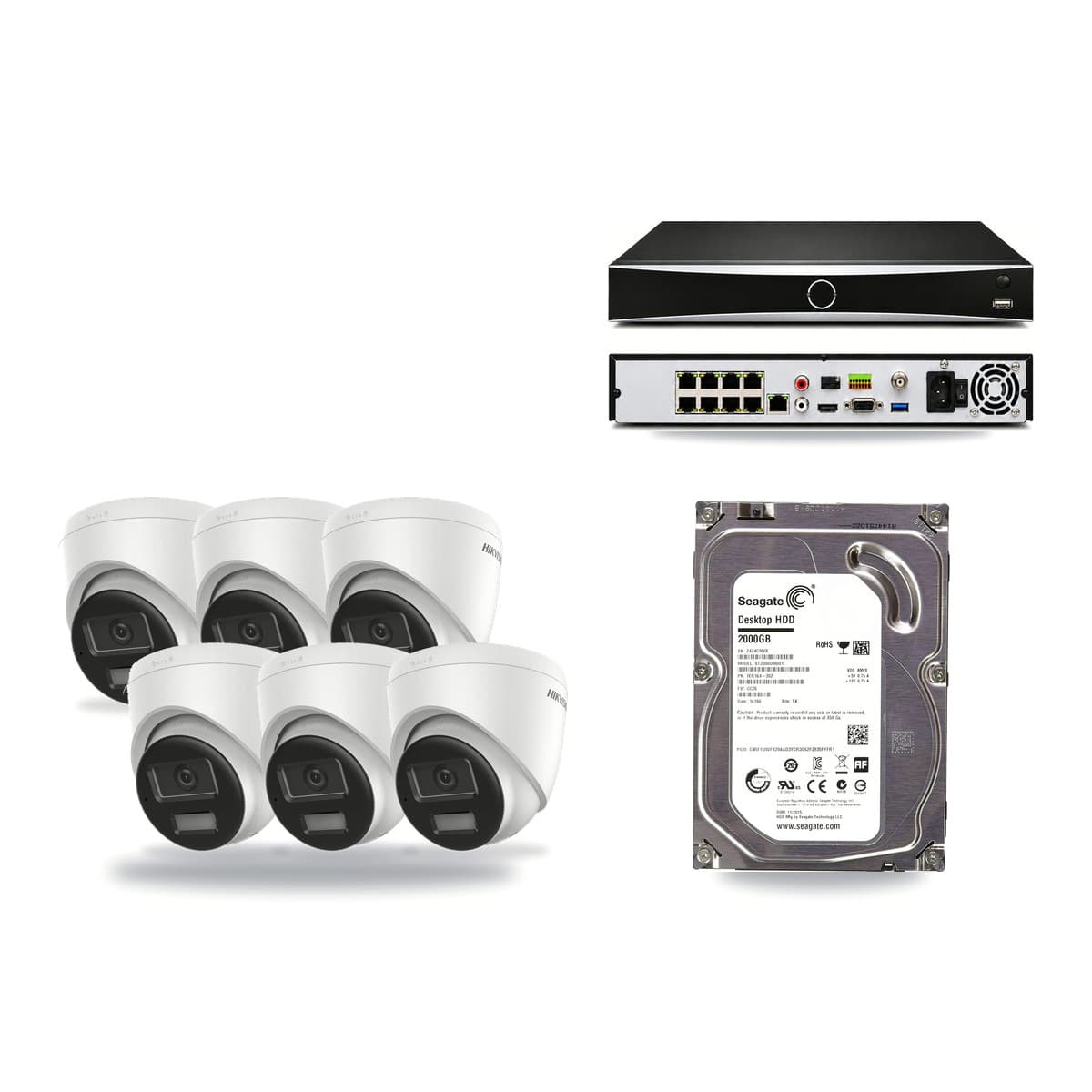
A typical UK three-bed house needs four to six cameras: one on the front door, one on the drive, one on the back door, one on the back garden and one on the side access. If the drive runs beside the front door, one camera can watch both and the house needs four, which is a 4-camera kit. If every spot gets its own camera, that is five, and the 6-camera kit is the one to buy. This guide walks round one example house to show how the count is made.
The example house
Picture a three-bedroom semi-detached house. It has a front door facing the street, a drive beside the house, a gate and passage down one side, a back door onto a patio and a rear garden of about 15m. The numbers change with your own house, but the method does not: walk round the outside and list every way a person can reach the property.
Camera by camera
- Front door. The camera goes above the door and sees whoever calls and any parcel left on the step.
- Drive. The camera looks along the drive so the car and the gate sit in one view. When the drive is right beside the front door, the front corner of the house can serve both spots with one camera.
- Side access. The gate and passage are the quiet way to the back of the house, so they earn a camera of their own on a semi-detached or detached house.
- Back door. A camera under the back eaves covers the door and the patio.
- Back garden. A second rear camera, or a wider view from the back wall, covers the garden and the fence line at the far end.
That makes five positions. Joining the front door and the drive gives four cameras; keeping all five apart gives five, and a sixth is room for a garage, a shed or a second view of the garden. The guide to where to place CCTV cameras explains the height and angle for each wall, and the CCTV planner counts the cameras for you when you tick the areas.
Which kit fits the count
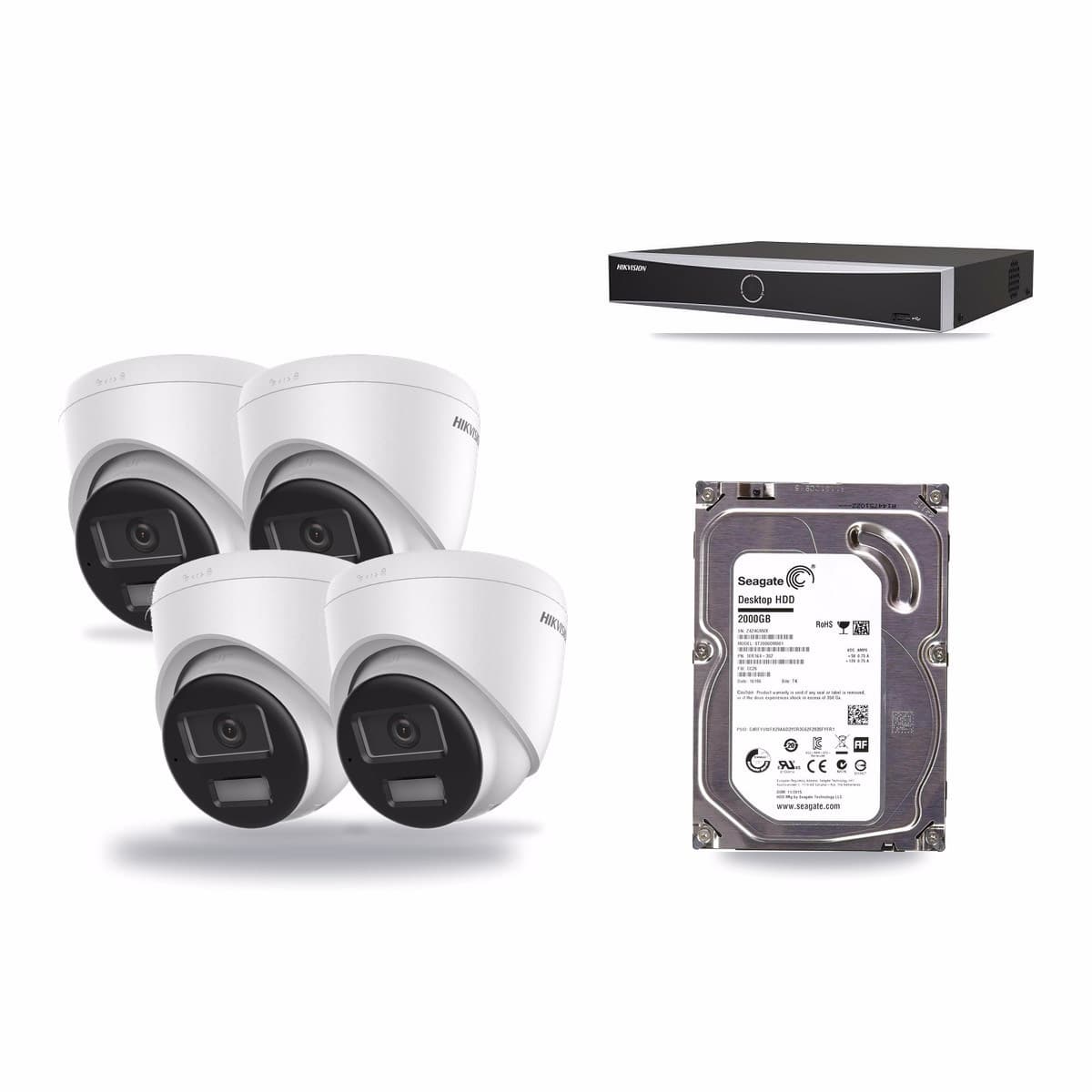
With four cameras, the Hikvision 4-Channel 8MP CCTV Kit with 4 cameras and 2TB fits exactly. It comes with a DS-7604NXI-K1/4P recorder, four DS-2CD1383G2-LIU 8MP turret cameras, the 2TB hard drive already fitted, a 1.5m HDMI cable and four 20m Cat6 patch cables. Its recorder has four channels, all of them used.
With five positions, take the Hikvision 8-Channel 4K CCTV Kit with 6 cameras and 2TB. It has a DS-7608NXI-K1/8P recorder with eight PoE ports, six DS-2CD1383G2-LIUF/SL cameras, a 2TB drive, a 1.5m HDMI cable and six 20m Cat6 patch cables. Six cameras for five spots leaves one camera for a sixth position, and the recorder has two ports free for more later.
Recorder and drive
Both kits arrive with the 2TB drive fitted, so there is nothing to choose in the box. The days of footage it holds depend on the bitrate you set. As a worked sum, a camera recording non-stop at 2Mbps writes about 21.6GB a day. Four cameras write about 86.4GB, so 2TB lasts about 23 days; six cameras write about 129.6GB, so it lasts about 15 days. Your real figure depends on the scene and the settings, so treat these as examples.
Check the cable runs
These are PoE cameras: each takes its power from the recorder over the network lead, so there is no power supply to fit at the camera. Every lead in the box is 20m. Measure the real route from the recorder to each spot, round corners and through the wall, before you order. Ask us before ordering if any camera is further than 20m from the recorder.
Keep the view on your own property
The Information Commissioner's Office (ICO) says that where possible you should position cameras to capture only your own property. If a camera also captures someone else's property, a public area or a communal space, data protection law applies, and you need signs showing that CCTV is in use. Front door and drive cameras are the ones that most often catch the pavement, so check each live view once they are up. Read the ICO guidance on home CCTV systems and the GOV.UK guidance on domestic CCTV.
If your house is different
A terrace usually needs only two or three cameras, and a large detached house needs more. The guide to kit size for a terrace, semi or detached house covers those cases. This one stays with the three-bed semi so the count can be followed step by step.